A practical FairDrive guide
How to use FairDrive to negotiate your car
You don’t need to be an expert negotiator to get a good deal on a car. The main things are putting out a few feeler emails and knowing what a good price looks like.
FairDrive gives you the good price, and from there, the easiest approach is usually to get a few dealers competing with each other, do as much of the negotiation as possible over email or text, and only go into the dealership once you’re reasonably happy with the price.
The basic strategy
The goal isn’t necessarily to get the lowest price anyone has ever paid. It’s to get a good deal while minimizing the time you spend either talking to dealers or being at the dealership.
Start by understanding the FairDrive numbers
There are a few different pieces of information on a FairDrive pricing page, and I’d use each of them a little differently.
Typical price: This gives you a sense of what buyers are generally paying. If a dealer’s quote is around this number, it may be a perfectly normal deal, but there’s probably room to do better.
Strong Deal: This is the price I’d feel good about trying to negotiate. It represents a price that’s meaningfully better than what most buyers are paying, while still being something that other buyers have actually achieved.
Best Reported: This shows one of the best prices FairDrive has seen. I wouldn’t have this as your goal—most dealers won’t match it. However, it never hurts to try.
The price distribution: Sometimes most buyers are clustered in a narrow range. Other times there can be thousands of dollars between an average deal and a very good one. That tells you how much room there may be to negotiate.
Raw Buyer Reports: The raw reports help you understand what sits behind the averages. You can look at things like location, trim, MSRP, dealer add-ons, taxes, and the final OTD price. I’d use these as information for yourself rather than something you need to show a salesperson. You don’t need to prove to a dealer that another buyer somewhere paid a certain amount. You just need enough information to know whether the quote in front of you is good.
I’d also check TrueCar and Edmunds. Their estimates may show less negotiating room than FairDrive’s buyer-reported data, but they’re well-known car-pricing sites. That makes their numbers useful as a conservative starting point you can bring to a dealership. If a dealer is willing to meet one of those estimates, you can keep negotiating toward the stronger prices you’re seeing on FairDrive.
Decide your price!
It helps to have a few numbers in mind before negotiations start. For example, imagine FairDrive shows:
Typical OTD: $41,200
Strong Deal: $39,800
Best Reported: $39,150
You might start by trying to get something around $39,300–$39,500 and feel very happy at roughly $39,800. If you get to $39,900, you’re probably not going to spend another two days trying to save $100.
You don’t need to start at the dealership
Find several dealers that have the car you want and contact them by email, text, or their website. If there’s plenty of inventory, contacting five to ten dealers is reasonable. If the car is harder to find, work with however many actually have one.
The first thing you want is simply a price. You do not need to tell the dealer your target price yet.
Initial message
Hi — I’m looking to buy a [YEAR MAKE MODEL TRIM]. I’m ready to purchase soon if the numbers make sense. Could you send me your itemized out-the-door price, including the selling price, dealer-installed accessories or add-ons, dealer fees, taxes, and registration? I’m contacting a few dealerships and would prefer to work everything out by email or text before coming in. Thanks!
Ask for an itemized OTD quote
The OTD price is ultimately what matters because it’s what you actually have to pay. A big advertised discount doesn’t necessarily mean you’re getting the better deal.
For example:
| Dealer A | Dealer B | |
|---|---|---|
| MSRP | $40,000 | $40,000 |
| Dealer discount | -$2,500 | -$3,200 |
| Add-ons | $0 | +$1,400 |
| Dealer fees | $300 | $600 |
| Taxes and registration | $3,200 | $3,200 |
| OTD | $41,000 | $42,000 |
Dealer B advertises a larger discount, but you’d still pay $1,000 more. This is why I’d always ask for the full breakdown. The selling price is still useful because it helps you understand why one dealer’s OTD is higher than another’s.
What to do about dealer add-ons
This is one of the easiest ways for a seemingly good deal to turn into a bad one. You may see paint or interior protection, security systems, VIN etching, wheel and tire packages, nitrogen tires, ceramic coatings, or other dealer-installed accessories.
If you don’t want the add-on, ask the dealer to remove it or discount the car enough to offset it.
I’m not interested in the protection package. I’m fine with the vehicle otherwise, but I’d need the selling price reduced by $1,495 so the package doesn’t increase my OTD price.
If the dealer says it’s already installed, you can simply say that you’re comparing dealerships based on the final OTD price and still need to be at your target.
If you actually want the add-on, that’s completely fine. Just treat its cost as part of the OTD price when comparing deals. For services like paint protection or ceramic coating, it may also be worth seeing what an independent shop would charge.
What if they won’t give you a quote?
Some dealerships will respond with some version of “Come in and we’ll work something out.”. To me, that's a red flag. Ultimately, I'm guessing they aren't able to give you a good deal, and they're relying on getting you in their dealership and tiring you out with their sales tactics so at the end of the day you just buy from them. That's the bad dealership experience that we're trying to avoid entirely.
If you want to keep the door open, you can reply with something like:
I’m happy to come in once we’re reasonably close on price. Before making the trip, could you send me your current itemized OTD quote for the vehicle?
If they still won’t give you a number and several other dealerships will, they clearly aren't going to be the ones you want to work with. Just focus on the dealerships that are friendly and flexible - most likely they'll be better to meet in person too.
Look at the breakdown to negotiate. Use OTD to decide which deal is actually better.
Once you have quotes, compare them to FairDrive
Dealer A: $41,050 OTD
Dealer B: $40,300 OTD
Dealer C: $39,950 OTD
Dealer D: Won’t give you a price unless you come in
Dealer E: $40,700 OTD plus a $1,495 protection package
If FairDrive shows a Typical price of $41,200 and a Strong Deal of $39,800, Dealer C is already giving you a pretty good quote. I wouldn’t spend time arguing with Dealer A about why their price is too high. I’d focus on the dealers that appear willing to compete.
Make a counteroffer
If a dealer gives you a quote that’s close but not quite where you want it, make a simple counteroffer a little below the price you’d actually be happy paying. That gives the dealer room to come back with something in between.
Thanks for sending this over. I’ve been looking at recent market pricing for this configuration, and I’m seeing strong deals around $39,800 OTD. If you can do $39,500 OTD with no additional dealer add-ons, I’d be ready to move forward.
Get dealers competing with each other
A real competing offer is great. If one dealer offers $40,000 OTD, you can go back to another dealer and say:
Another dealer has offered me $40,000 OTD on the same configuration. I’d prefer to buy from you if you can beat that. Could you do $39,700 OTD?
There’s no reason to invent offers. If you’re contacting several dealers, you’ll usually have real quotes to work with.
Know when to stop
If FairDrive says a Strong Deal is $39,800 and you’ve negotiated a dealer down to $39,850, you probably haven’t failed because someone else once paid $39,300. You already have a very good deal.
You can always ask once more. But think about what the remaining savings are actually worth to you. Is saving $300 worth driving two hours farther? Is it worth risking the exact car you want being sold to someone else?
The closer you get to the Strong Deal range, the less important each additional dollar probably becomes.
A few things that can make this easier
Expand your search radius. Driving an extra hour can sometimes save more money than hours of additional negotiating.
Shop vehicles that are actually comparable. Dealer competition works best when several stores have the same trim and similar equipment.
Keep negotiations in writing. It’s much easier to compare quotes when you have the numbers in front of you.
Be ready to buy. Dealers are more likely to take your offer seriously if you can actually move forward.
Try near the end of the month if the timing works. Sometimes dealers are more motivated to close a deal, but there’s no guarantee.
Be polite and concise. You don’t need to turn the negotiation into a fight.
Don’t negotiate against yourself. Make an offer and give the dealer a chance to respond before increasing it.
Be willing to walk away. This becomes much easier when you’re already talking to several dealerships.
A real-life example when I bought my Golf GTI
In 2017, I was shopping for a new Volkswagen Golf GTI Sport with a manual transmission. I did most of the negotiation over email. Keep in mind, this was before people started posting their own experiences on Reddit, Facebook etc, so I had to figure out what a strong deal was myself by emailing a ton of dealers. Hopefully the data from FairDrive means you can skip that part and just go to dealers with a good expectation as to what a good deal is.
1. I asked for an itemized out-the-door quote
I started by emailing dealers and asking for a written OTD price, including taxes, fees, and add-ons.
One dealer sent back a fully itemized quote and even said the detailed request made things easier.
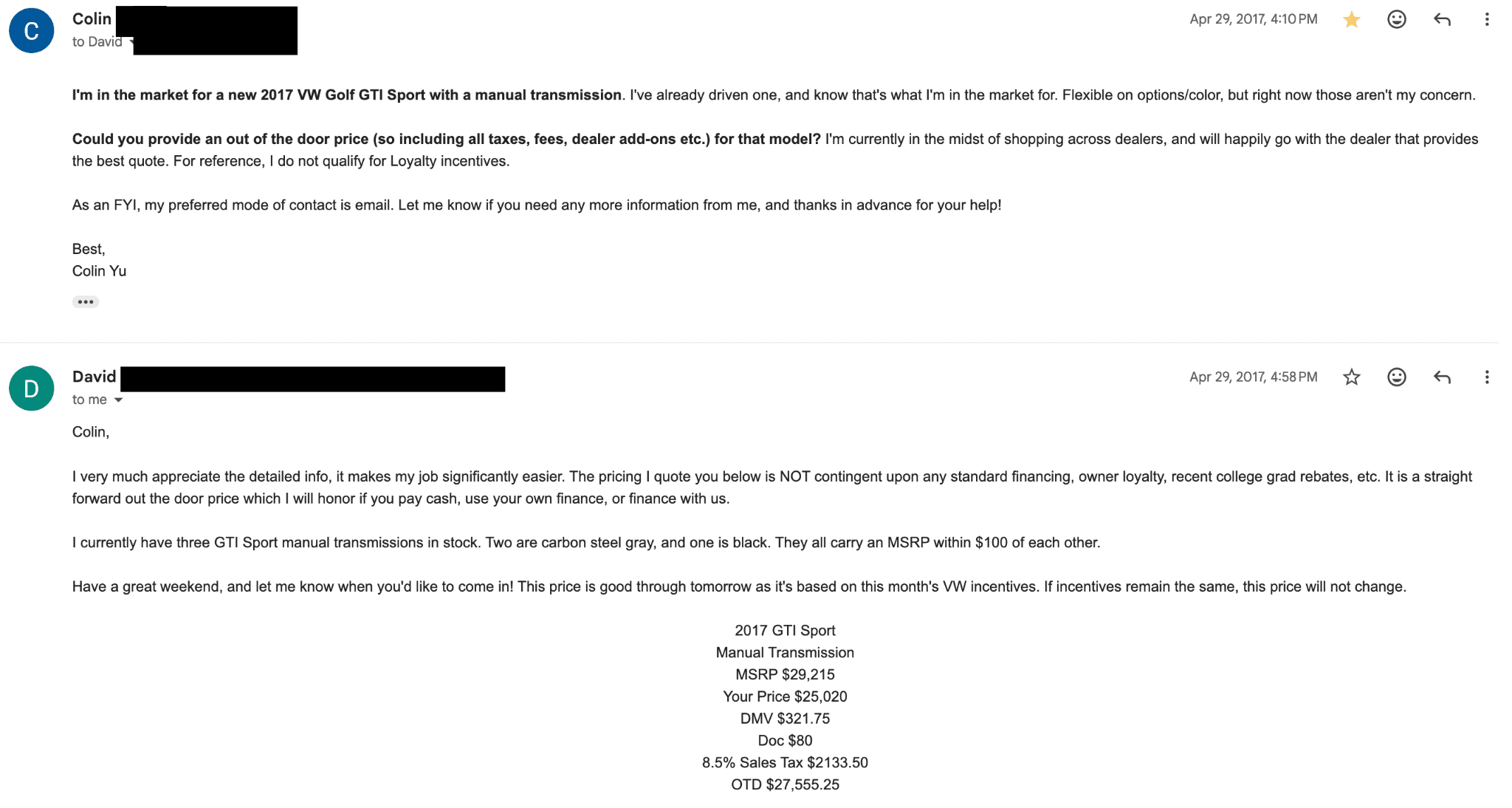
Their quote was:
MSRP: $29,215
Selling price: $25,020
OTD: $27,555.25
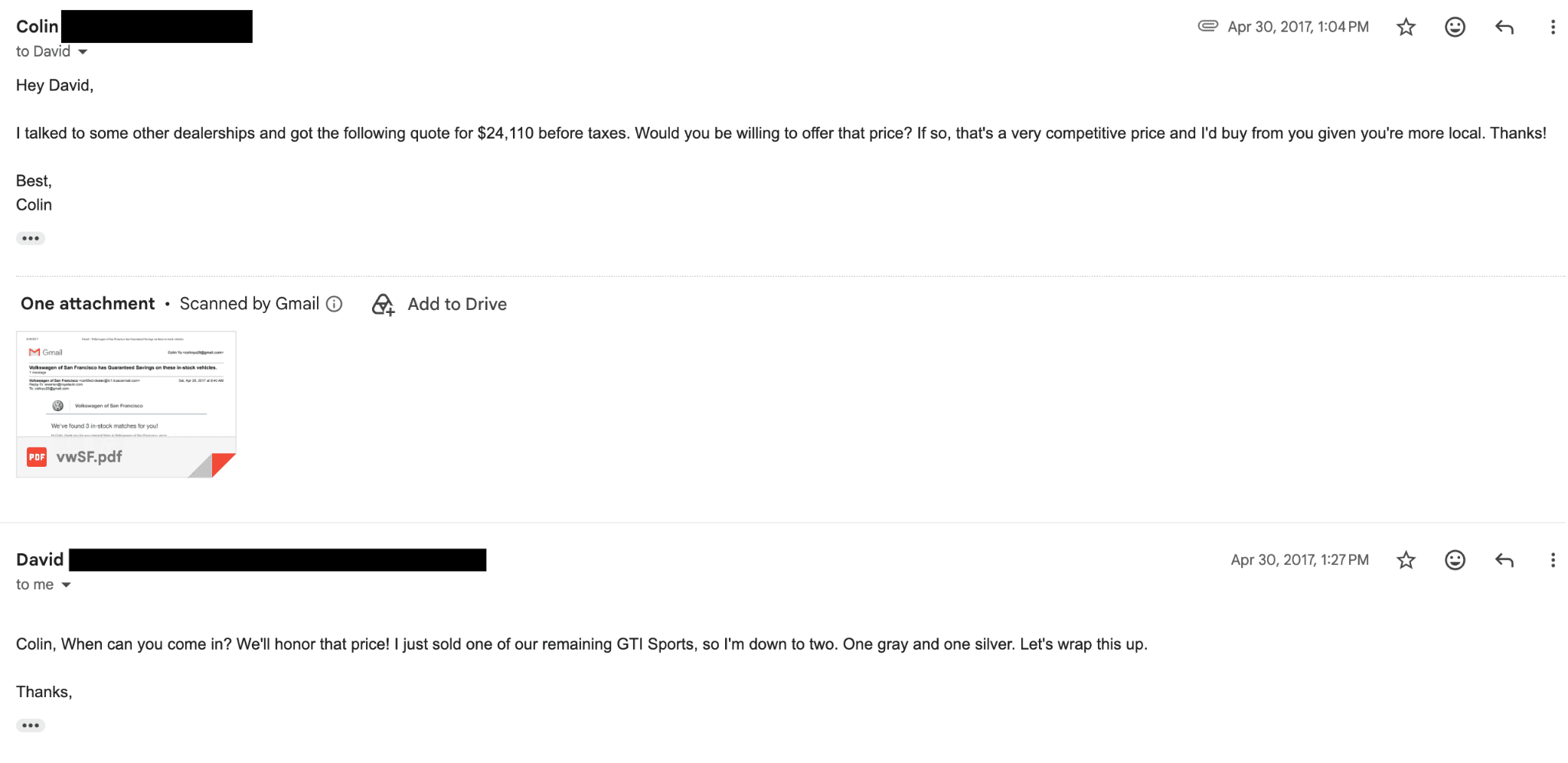
2. I got a better written offer and negotiated with the original dealership
After shopping around to other dealers, I found a stronger quote. $24,110 before taxes and fees, which was ~$900 cheaper than the original dealer's quote. I sent that back to the local dealer and asked if they would honor it. They replied: “We’ll honor that price!”
3. I used the same offer to see if anyone else could beat it
Then I took that offer to other dealers and asked whether they could beat it by a meaningful amount.
One of them replied:
“Yeah that is super aggressive and I think you should go and get it from them. Especially if they are local.”
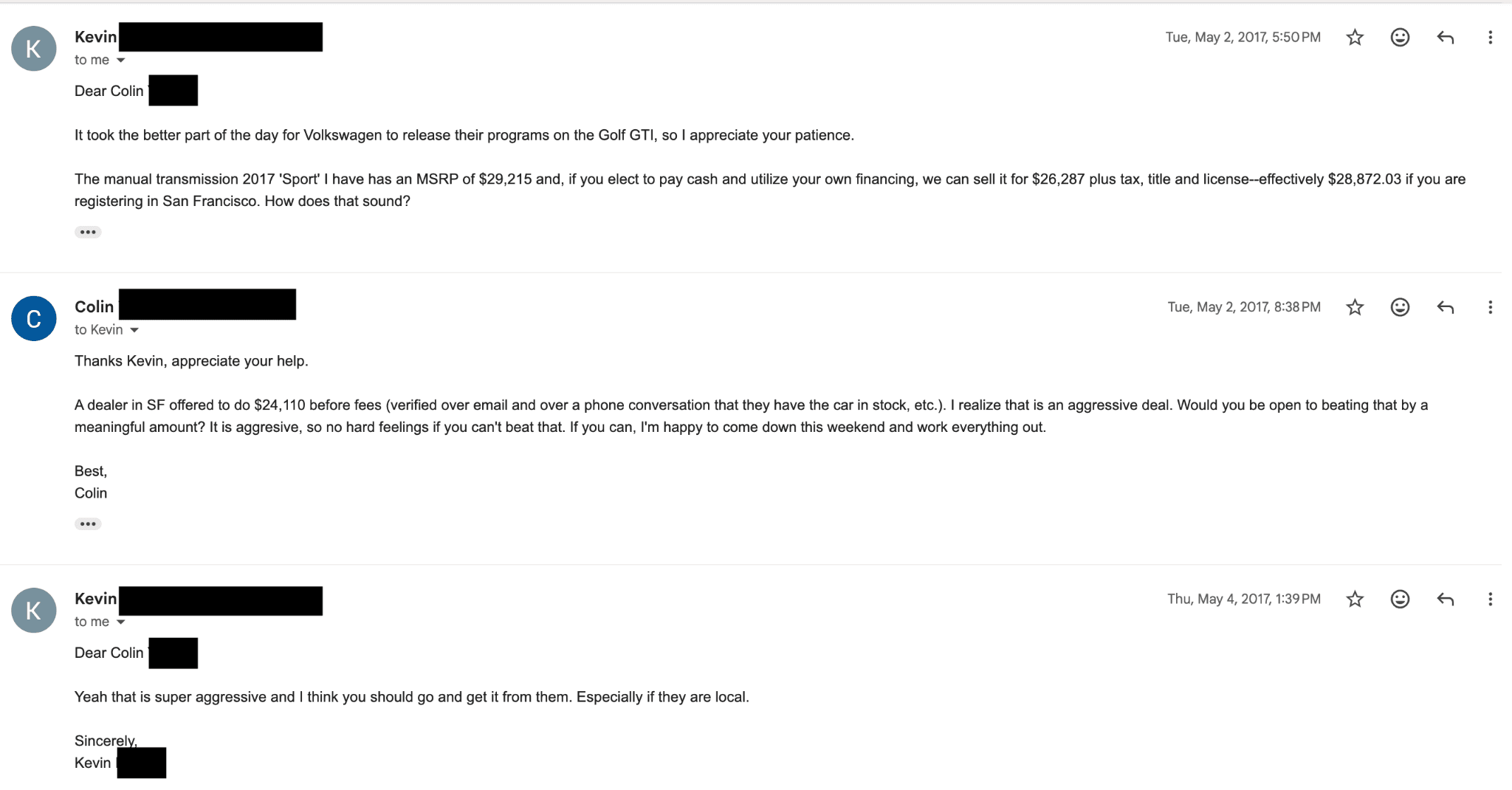
That response was actually pretty useful, as it was good confirmation that I already had a strong deal.
4. Then I stopped negotiating and bought the car
I think I probably could've kept talking with dealers and negotiating a few extra hundreds off, but in the end I think I was already very close to the cheapest price, and there was a dealer just 2 miles away from me that was willing to sell me the car at that price.
That’s really the point of this strategy. You don’t need to negotiate forever. You need to know what a strong deal looks like, get a few real quotes, and stop when you get a deal that feels fair.
FairDrive is there to help you understand the market before you negotiate. You don’t need to convince a dealer that the data is right. You just need to find a dealer willing to give you a good price.
Find pricing for your vehicle